
.png)
Non-Places: The Spaces That Shape Us
- purnimasadhana
- Jun 13, 2025
- 2 min read

Updated: Jul 19, 2025
Airports, hotel corridors, runways. Designed for movement, not memory. But for the crew, these so-called non-places become stitched into our identity.

Non-places are considered products of super-modernity—airports, malls, highways, runways, and hotels. As flying crew, we spend much of our lives in these spaces and form an invisible bond with them. Even years later, when someone mentions a city, what comes to mind aren’t the tourist brochures—it’s a specific hotel room, a security checkpoint, or the quiet hum of a boarding gate.
We follow crew protocols unique to each country and quickly adapt, almost like choreography. These cities may have ancient histories or breathtaking landscapes, but our lives are mostly confined to the transitional spaces: the airport-to-hotel drive, the artificial waterfalls, the murals in the hallway. You won’t find them on satellite maps—but you’ll feel them if you’ve lived them.
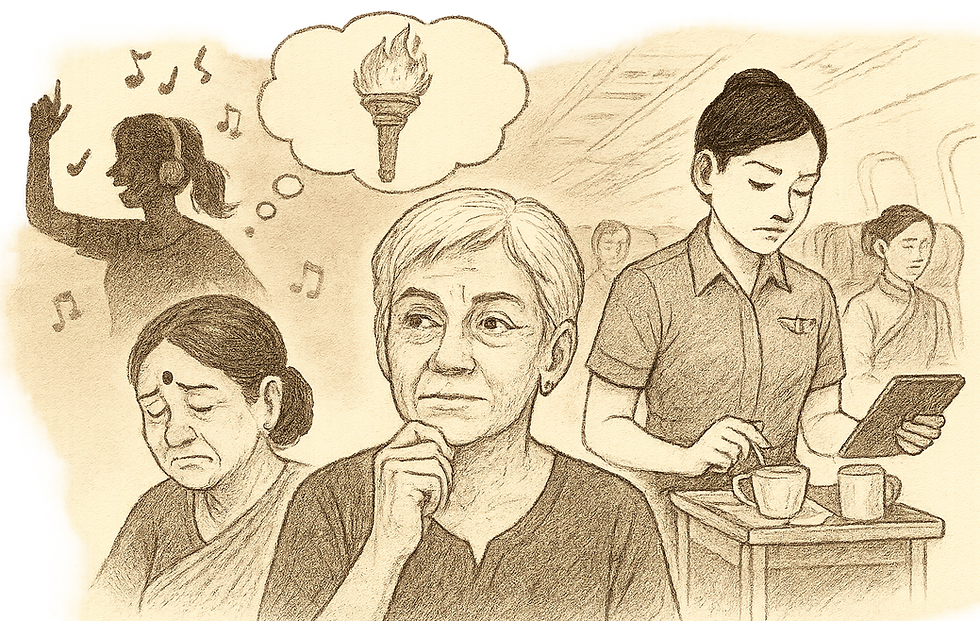
For travelers, these places are designed for function and speed. Someone is always arriving; someone else is just passing through. They are built for transience, not attachment. Most travelers don’t form memories in these spaces—they move through them. They feel sterile, interchangeable, emotionally vacant.
But for crew? These spaces slowly become part of us.I remember a time when airports weren’t as crowded or competitive. I could glide through the same route—turn right, walk ahead—and know exactly where to find immigration or the check-in counter. It became second nature, like muscle memory. Robotic, perhaps—but always with a smile.
As flying crew, we carry not just uniforms and ID cards—we carry empathy, compassion, and our small rituals. The duty-free shops, the seasonal sales, the hotel breakfast corners… all become tied to memory and identity. In this way, non-places stop being empty. They become lived. And in that living, they gain shape, colour, and emotion.
In today’s world—fragmented by migration, digitisation, and growing divides—these non-places offer a quiet resistance. They remind us how belonging is built. Not always in grand moments, but in fleeting routines: the hotel corridor that smells like jet fuel and fresh linen, the security officer who smiles back, the corner café with your favourite crew discount.
Sometimes, I truly feel these spaces were designed for us. Perhaps shaped by the powerful, yes—but lived in, transformed, and remembered by those of us who passed through them with purpose.
And in that passing—there is transformation.Not always loud. Often subtle.But enough to shape a person. To shift their center of gravity.
Does a non-place live in your memory too?
A hotel hallway. An airport scent. A moment that never made it to your journal—but stayed in your heart.
Comments